

Judge Pushes Through Termination of Parental Rights with Unlawful Court Proceedings
Parents Attorneys Begin Appeal
Attorneys for parents Joel and Donelle are working quickly to appeal the termination of the family’s parental rights by a Brown County jury, after 35th District Court Judge Mike Smith appeared to orchestrate the result in favor of CPS. After openly and repeatedly instructing CPS and the child’s ad litem attorney on how to skirt the rules of evidence and procedure in favor of adoption, Judge Smith intentionally withheld instructions from the jury on Texas’s two strongest parental rights laws. All of this took place over the repeated objections of Joel and Donelle’s attorneys, Chris Branson and former State District Judge Mike Schneider.
The Texas Constitution guarantees parents the fundamental right to raise their children. The Texas Family Code requires that, before any “non-parent” can interfere in the parent-child relationship, the non-parent must prove that the interference is necessary to protect the child from significant harm. Judge Smith informed the attorneys at trial that he did not consider CPS to be a “non-parent” and that, consequently, he would not require the Department to overcome the parental presumption before allowing termination of Joel and Donelle’s parental rights. Texas distinguishes only two groups: parents and non-parents. The law does not recognize any third category or place CPS in a special category.
In a jury trial, a judge is required to provide instructions to the jury on the relevant laws that they must follow when deciding the case. However, Judge Mike Smith specifically excluded these two most relevant laws from the jury instructions, guaranteeing that the jurors would make their decision without instruction on the two strongest—and most relevant—parental rights laws in Texas.
Judge Smith’s egregious conduct in the case indicated early on that he was paving the way for CPS when he approved CPS’s flat-out and repeated refusal to produce key documents and records that the rules of evidence obligate them to produce before trial.
In all of FFP’s time defending families in Texas, never before has our team witnessed such a blatant abandonment by CPS, the ad litem attorney, and a trial court of the goal of justice in favor of winning at any cost.
Background
For nearly two and a half years, Joel and Donelle have been fighting CPS for the return of their daughter, Rose. In early December of 2023, Joel and Donelle brought Rose to the hospital because her weight gain was slow. Rose was diagnosed with Failure to Thrive. Failure to Thrive is a diagnosis that indicates a difficulty in gaining weight, but it does not by itself indicate any particular cause.
Doctors from Hendrick’s Medical Center accused Joel and Donelle of not feeding Rose properly, and repeatedly derided both parents in medical records as being “on the autistic spectrum” before reporting them to CPS. Neither parent has an autism diagnosis.
Joel and Donelle pressed doctors to investigate other explanations, specifically and repeatedly asking that Rose be tested for any conditions she may have been born with. Doctors refused to do so.
In late December 2023, Joel and Donelle brought Rose to Cook Children’s Hospital, seeking a specialized evaluation, expressing frustration to Cook Children’s that doctors from Hendrick’s were “not doing anything.” After returning from Cook Children’s, Rose had one more visit to Hendricks’ Medical Center in early January 2024.
Then, on the night of January 9, 2024, Rose’s weight dropped by one ounce. On this basis, CPS sought an emergency order for the removal of Rose from her parents. No concern of any kind was raised other than Rose’s Failure to Thrive.
At the first court hearing on January 25, 2024, the judge at the time (a different judge) gave custody of Rose to a private company, 2INgage. 2INgage is the private company that has contracted with CPS to take custody of all children removed from their parents in the region. At this hearing, the court appointed Patrick Howard as an attorney Ad Litem for Rose. An Attorney Ad Litem has an obligation under the law to represent the interests of the child independently from CPS and 2INgage. In fact, the law presumes that the return of the child to the child’s parents should be the primary goal.
However, it was later discovered during the trial that Patrick Howard’s wife, Mika Howard, is an adoption specialist at 2INgage–meaning that she is tasked with finding families to adopt children like Rose–i.e., children her husband Patrick Howard is ethically obligated to attempt to return to their families. This blatant conflict of interest was ignored by Patrick Howard, CPS, and the trial court. Patrick Howard is now running for County Judge in Brown County. He is seeking to replace a judge who was removed from office for intimidating witnesses and other criminal offenses.
At the January 25, 2024 hearing, at the insistence of the parents, the original judge ordered that Rose be taken to specialists to determine whether any underlying medical conditions or genetic problems explained her Failure to Thrive. For a year and a half, CPS, 2INgage, and Patrick Howard disregarded the judge’s order and failed to obtain genetic testing on Rose despite repeated requests by the parents during this time. Finally, Rose obtained genetics testing through Baylor, Scott, & White first and then Cook Children’s Hospital in June of 2025–the same institution that Joel and Donelle had asked CPS to obtain specialized assessments from a year and a half earlier.
The genetic test revealed multiple genetic mutations in Rose. The report specifically and explicitly identified genetic problems with feeding and low body weight. It also showed other potentially life-threatening genetic problems that Rose needed immediate assessment for.
Rather than acknowledging the mistake, admitting the parents’ innocence, and obtaining immediate care for Rose’s serious genetic issues, CPS/2INgage falsely represented to the family that the genetic results did not indicate any feeding or weight-related issues. However, the agency finally agreed to relent and send Rose home on a “monitored return,” which allowed Rose to live with Joel and Donelle but under strict CPS supervision.
The parents believed that the monitored return was done in good faith, but just two months later, in October 2025, CPS removed Rose again, this time citing concerns about a “messy” home. Under questioning at trial, multiple caseworkers from CPS and 2INgage testified under oath that the “messy home” would not have been grounds for a normal removal of Rose from her family, but that, because the agency still technically had custody, they were allowed to take Rose anyway.
On January 7, 2026, an even more detailed genetics report was issued, clearly explaining how Rose’s underlying genetic conditions “best explained” her Failure to Thrive. Shortly thereafter, FFP Senior Fellow Chris Branson joined the case to defend Joel and Donelle.
At the next hearing in February, when Chris Branson specifically asked the CPS/2INgage caseworker about the genetics report, she flatly lied under oath on the stand and told the court that “there was nothing in the genetic testing regarding weight gain.” An expert witness for the parents was standing ready at the hearing, prepared to give testimony on the genetics issue. But immediately after hearing the testimony from the caseworker, Judge Smith informed the parties that he would not allow the expert to testify because he did not want to hear the testimony at that time.
The law required that Rose be returned home at that time unless a continuing danger was found that prevented Rose’s return. By excluding the parents’ medical expert from testimony on Rose’s genetic condition, Judge Smith was able to portray the issue as unresolved and claim that a “continuing danger” prevented Rose’s return. Based on this, rather than return Rose home, he forced the parties to trial.
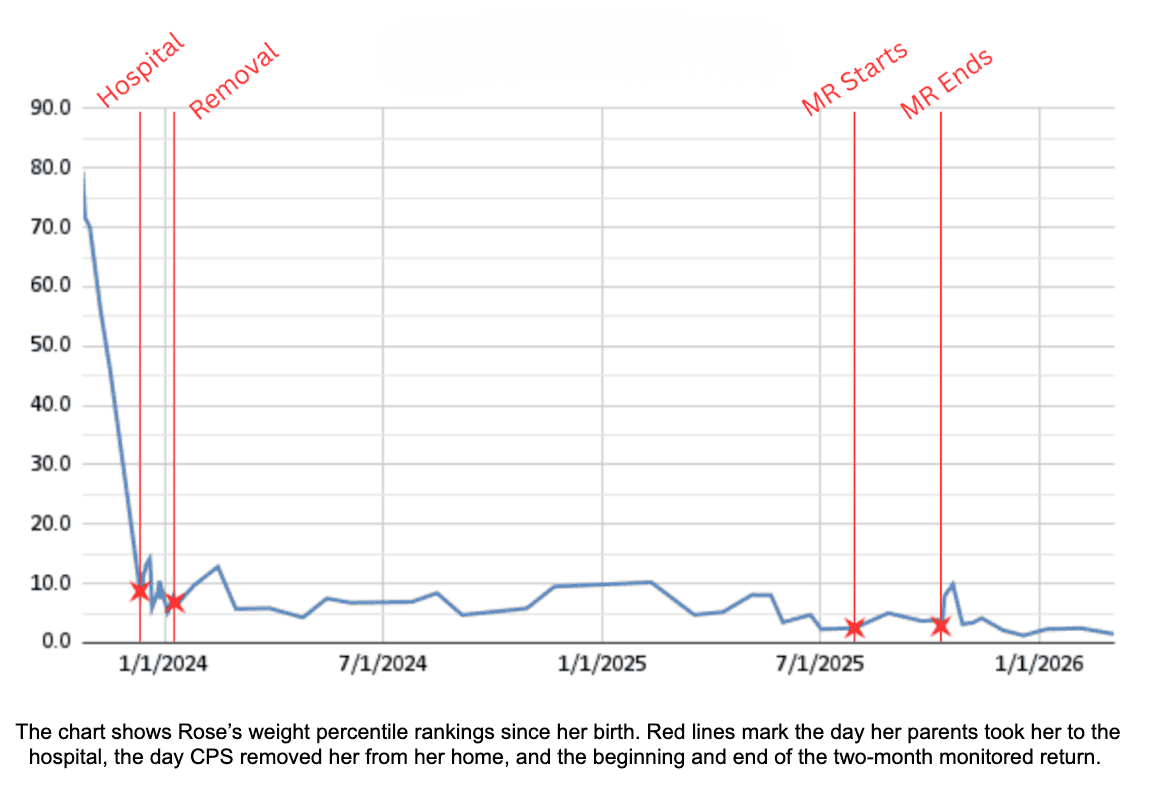
At trial, the below weight chart for Rose was presented, and expert witnesses testified on her genetic condition. As shown in the chart, when Rose was born, her weight percentile immediately began to plummet. Weight percentile measures a child’s weight compared to other children her age. Within two months, Rose fell from near the 80th percentile at birth to near the 10th percentile. For the next two years in CPS/2Ingage care, Rose’s weight percentile entered a slow, spasmodic decline.
During the entire case, CPS continually misled the court and reported that Rose’s weight was healthy. By March of 2026, just two weeks before trial, Rose’s weight percentile had reached 1%–the lowest of her entire life.
At trial, the parents’ medical expert was finally allowed to testify. He explained that there is no possible way that Rose’s lifetime of declining weight percentiles for two and a half years across multiple caregivers in multiple homes can be attributed to the act of any person–especially with the genetic finding of her strong predisposition toward weight problems.
Nevertheless, CPS/2INgage simultaneously argued at trial that when Rose struggled to gain weight for the first 3 months of her life living with the parents, it was the parents’ fault, but that when she struggled to gain weight for the next two and a half years in CPS/2INgage’s care, it was not the fault of CPS, 2INgage, or the foster care placement.
After two and a half years of delaying proper medical testing and lying to the court about Rose’s weight and medical issues, CPS/2INgage were faced with the prospect of either acknowledging their mistake and returning Rose home or engaging in ruthless obfuscations of the law, their duty of care toward Rose, and the rules of legal procedure and ethics.
For CPS/2INgage, Judge Smith, and ad litem Patrick Howard, burying innocent parents and destroying a family was the more acceptable option. Clearly, their unwavering goal of termination of parental rights and adoption by others trumped the best interests of Rose. FFP and the family’s legal team will continue to tirelessly defend the family before the Court of Appeals in order to bring accountability to the system and reunite Rose with her family.
Editor’s Note: The names of the parents and child in this case have been changed because of the sensitive and disparaging nature of the neurodevelopmental allegations.
The Original 3-Part Story
Part One: CPS Investigation and Removal
When Texas Child Protective Services removed newborn Rose from her parents’ care in January 2024, they cited concerns that her parents were not “mentally capable” of caring for her. A month earlier, a hospital worker had called CPS after medical providers, based on casual observations and without any sort of assessment, repeatedly labeled the parents as “apparently both on [the] autistic spectrum.”
Neither the doctors or CPS conducted any assessment for autism or provided any services or accommodations based on that theory.
Ostensibly, CPS claims that the removal was necessary because Rose’s weight gain was struggling and the parents were not feeding her properly. But hundreds of pages of medical and court records tell a more complicated story.
During a one-month period prior to Rose’s removal, CPS and doctors appeared hyperfixated on every ounce of Rose’s weight fluctuation. Yet, after CPS removal, Rose’s weight percentile rankings continued to fall for the next two years under state custody.
Nevertheless, within weeks of Rose’s removal, CPS and medical providers began describing her weight as “doing well,” “thriving,” and “not concerning”–despite her weight rankings repeatedly falling below where they had been in her parents’ care.
That rhetorical reversal—combined with the same repeated descriptions of Rose’s parents as “slow,” “developmentally delayed,” or as being on the autistic spectrum—is now the subject of a federal civil-rights lawsuit alleging violations of parental rights and unconstitutional discriminatory treatment.
It has now been two years since Rose was taken by the state. CPS is no longer working to reunite her with her parents. Instead, the agency has officially shifted its goal toward non-relative adoption and has requested that the court block all visits between Rose and her parents.
On February 6, 2026 a hearing will be held in the CPS case, where Joel and Donelle will have one final chance before trial to petition the court for Rose’s return.
Given their complicated situation, Joel and Donelle reached out to Family Freedom Project. FFP leveraged its network of defense attorneys and civil litigators, compiling a team to defend the family, reunite them with their daughter, and file a federal civil rights lawsuit against CPS and several medical providers.
Seeking Medical Help
Rose was born in October 2023. From birth, hospital records reflect heightened attention not only to her feeding, but to her parents themselves. Notes from December 2023 reference social services involvement at the time of birth due to “concerns about parents as caregivers due to the apparent autistic spectrum disorder in both.”
When Rose was born, Joel and Donelle actually sought out and completed parenting classes to help them prepare for parenthood.
In November of 2023, Rose began having difficulty eating. Joel and Donelle took her multiple times to the pediatrician’s office for advice–the same pediatrician who had seen Rose at birth.
Then, in December of 2023, Rose’s weight rankings dipped below the 10th percentile. There are many factors in a child’s weight and being high or low on the weight charts does not, by itself, indicate either good health or poor health.
On December 11, Joel and Donelle took Rose to Hendrick’s Medical Center in Brownwood, Texas. That visit marked a turning point. The records note a concern that both parents appeared to be on the autism spectrum, and then again repeatedly describe both parents in derogatory terms as “slow”, “developmentally delayed”, or “lower functioning.”
CPS Intervention
On the second day in Hendrick’s Medical Center, a report to CPS was called in.
CPS very quickly became a fixture in the family’s life. Hospital staff documented multiple times that the parents were able to follow feeding instructions. Yet attention increasingly shifted toward a focus on the parents’ perceived mental capacity. One doctor reported to CPS that he had “concerns about parents’ competency” and asked CPS to ensure that a “competent adult” was checking in on Rose daily.
But at no time did any doctors or CPS conduct any assessment for autism or provide any services or accommodations based on that theory.
After Rose was released to go home on December 16, CPS instructed Joel and Donelle to obtain 24/7 supervision–requiring other adults in their life to watch their every move with Rose at all times of the day and night and to help keep detailed logs of her feedings.
Throughout December, Rose’s weight percentile rankings fluctuated around the 10th percentile. A child in the 10th percentile on the weight charts would be heavier than 10% of children her age, and lighter than 90% of children her age. Medical records for Rose show frequent weight checks, formula changes, and feeding adjustments—all at the direction of healthcare providers. When weight gain lagged, the parents returned as instructed. But weight lags of even a single ounce were quickly registered as evidence of the parents’ inability to care for their child.
Yet, the records also reflect the parents’ frustration with medical providers who they felt were not addressing Rose’s needs. In late December, they brought Rose to Cook Children’s Medical Center, telling the doctors there that other medical providers “aren’t doing anything.”
At Cook’s, clinicians documented that Rose remained small—around the 9th percentile—but noted she was alert, hydrated, and not in distress. They concluded she did not meet the criteria for inpatient admission. Cook Children’s doctors switched Rose’s formula again, noted several potential medical explanations for her poor weight gain that could warrant further investigation, and sent her home with instructions that she see her primary care physician often for checkups.
Back at home, CPS repeatedly pressured Joel and Donelle to maintain adult supervision at all times of the day and night, something Joel and Donelle informed them was impossible because no one they knew could make that commitment. The agency later cited this as evidence of their inability to care for Rose.
Removal
From January 3-8, 2024, Joel and Donelle took Rose back to Hendrick’s Medical Center because they felt she was still struggling to eat well. On January 4, the hospital noted again that the “Parents [are] apparently both on [the] autistic spectrum.” Again, no assessments of any kind were conducted.
On January 8, Rose was discharged. The discharge summary is explicit: medical testing was normal; Rose had fed well; and providers believed the parents were capable of following feeding instructions at home. Simultaneously, they expressed concern about the “situation at home”, stating that “a change in home situation is necessary for Rose to thrive.”
The next day, January 9, Rose was seen again for a regular checkup. In CPS documents filed with the court, the agency records that it “learned that Rose dropped an ounce last night.” That same day, CPS filed a petition with the district court alleging that Rose was in “immediate danger” and seeking approval for her immediate removal from Joel and Donelle.
The request was granted.
At the first court hearing on January 25, 2024, no testimony was taken. No medical records were discussed. Instead, CPS framed the case to the court as a simple situation where CPS merely needed to “train” the parents on proper feeding techniques, and then they could have their daughter back. The entire hearing took 15-30 minutes.
Joel and Donelle were both given court-appointed attorneys. Relying on CPS’s stated intent to reunify Rose with her parents after some simple “training”, the attorneys recommended to Joel and Donelle that they not fight the removal. They could just complete some simple classes, get their daughter back, and CPS would be out of their lives.
Based on this recommendation, Joel and Donelle agreed. That was two years ago.
The Aftermath
A final trial is scheduled for March 30. CPS is now seeking court authorization to adopt Rose out and to block all visits with Joel and Donelle.
In November of 2023, Joel and Donelle sought medical help for their newborn daughter when they saw her having trouble feeding. Now, a little more than two years later, they face the prospect of never seeing her again.
CPS still attempts to justify its actions with vague references to weight concerns. However, hundreds of pages of records show that for two years the agency has been repeatedly dishonest with the court about the true nature of Rose’s weight trends, and has gradually shifted the narrative to focus on how she is “bonding” with her temporary caregiver.
The prospect of being reunited with Rose has been repeatedly dangled and withdrawn, often following brand new allegations that arose just in time to prevent reunification, but which were quietly dismissed and discarded later by CPS.
For Joel and Donelle, the process itself has been a perverse punishment. If you ask them today, they will tell you that they never imagined that seeking help for their daughter could come at such a high cost.
______________
End Note: This is part one in a three-part series about the unlawful removal of Rose from her family. Part two is scheduled to be published next week. Some names have been changed to protect identities.
Part Two: The Narrative Flips
The next part in our three-part series about CPS’s unwarranted removal of Rose from her family
In the month before removal, Rose’s weight was repeatedly framed as alarming while she was in her parents’ care. During this time, her weight averaged the 10th percentile, which means that she was heavier than 10% of girls her age. Throughout this ordeal, both before and after the removal, Rose’s parents never stopped asking, even at times begging, for doctors to look into a medical reason for their child’s perplexing weight fluctuations.
After removal, Rose’s weight percentile rankings continued to fall for the next two years under state custody. Texas privatized its foster care system several years ago. So when Rose was removed, purview over the case was given to the private company that contracts to run the foster care system in that area.
In repeated reports to the court and in testimony, these CPS contractors continually described Rose’s weight in state custody as “doing well,” “appropriate,” and “not concerning.” In one 2024 filing, a medical provider described a “history of failure to thrive” but stated that Rose was now “on the growth charts and developmentally doing well”, despite recorded weight percentiles remaining in the single digits.
This pattern continued for more than a year and a half. Under CPS care, Rose continually registered weight percentiles in the single digits. CPS contractors presented her to the court as “thriving.” Joel and Donelle worked through and completed each of the services CPS contractors gave them, including parenting classes and therapy. But reunification with Rose was somehow always just out of reach.
At each hearing, CPS contractors provided updated reports claiming that, in their opinion, Joel and Donelle just weren’t ready yet. Meanwhile, Rose was reportedly “bonding” with her caregiver and growing and developing on schedule.
Hopes Kindled, and Dashed
In July of 2025, after a year and a half of running on the proverbial treadmill with no acknowledgement of their progress on the service plan, Joel and Donelle’s court-appointed attorneys managed to negotiate a “monitored return” agreement. This allowed Rose to go home, but under strict CPS and court supervision.
After a year and a half of separation, Joel and Donelle believed that the nightmare was finally drawing to a close. They were reunited with Rose, even if it was under the watchful eye of the system. They breathed a cautious sigh of relief. But it didn’t last long.
On October 7, 2025, Joel and Donelle’s court–appointed attorneys filed a motion to dismiss the case, asking for Rose to be permanently left in their care and for CPS to cease any further action in the family’s life. The very next day, the caseworker assigned to Rose filed an affidavit with the court asking for an emergency removal of the child from the monitored return. On November 10, the judge signed the order to disrupt the monitored return, and Rose was traumatically removed from her parents a second time.
In the request for removal, the caseworker gave her statement as to the claimed emergency: she outlined concern with various tasks that the parents had allegedly not completed to her satisfaction and documented a surprise visit she had made to the parents’ home, where she found it to be too dirty for her liking. The caseworker also described clashing with extended family members who objected to CPS’s ongoing involvement in the family.
Yet, at the October 14 hearing following the removal, the narrative again returned to weight concerns.
Records show that Rose had already fallen to her lowest weight rankings ever recorded before she reentered her parents’ care on July 30, 2025. Nevertheless, at the hearing on October 14, after CPS took Rose from her parents a second time, the CPS caseworker testified that when she went to pick up Rose, she quickly ate the snacks and drinks provided to her.
On this basis, the caseworker speculated that Rose was “not being fed properly.” Subsequent court filings and testimony show that the CPS contractor immediately began describing Rose’s weight as positive again once she was no longer in her parents’ care.
Shifting Blame
Analyzing Rose’s overall weight trends since the date her parents first sought medical help provides a stark contrast to CPS’s original emergency narrative, as well as to their ongoing claims that Rose does better in state care.
The sole exception to CPS’s narrative that Rose’s weight was improving came when CPS told the court that Rose’s weight had suffered during her two-month monitored return to Joel and Donelle in the summer of 2025.
Unmentioned was the fact that when CPS had dropped Rose off with Joel and Donelle in July of that year, she was already at the lowest weight percentile ever recorded.
This impossible contrast between Rose’s consistently low weight rankings in CPS custody and the state’s consistently misleading narrative to the court unveils a darker side to the case, which is now the subject of the lawsuit filed by Joel and Donelle’s civil rights attorney: That Rose was not taken or kept by CPS because of a medical emergency, but rather because the state viewed Joel and Donelle’s perceived autism spectrum status as making them unfit to raise their daughter.
______________
End Note: This is part two in a three-part series about the unwarranted removal of Rose from her family. Part three is scheduled to be published soon. Some names have been changed to protect identities.
Rose Part 3: A Destructive Game
The final installment in our three-part series about CPS’s unwarranted removal of Rose from her family
During Rose’s time in state custody, Joel and Donelle found themselves in a state of perpetual limbo—one in which reunification was always promised, but never honestly pursued.
CPS placed a growing list of requirements on Joel and Donelle: parenting classes, counseling, therapy, psychological services, supervised visitation–all of which required extensive travel. They were required to submit to drug testing, despite having never been accused of using drugs by CPS or anyone else.
Very quickly, the case shifted away from a few classes on infant feeding and into a bureaucratic insistence on compliance with CPS demands. Every CPS update to the court ended the same way: Joel and Donelle were still “not ready.”
This pattern unfolded alongside a striking contrast with how CPS discussed Rose’s well-being depending on who was caring for her. When she was initially removed, Rose was placed with a “temporary” caregiver, where she would remain for most of the next two years.
The caregiver, although not a blood relative of Rose, had married an extended family member of Donelle’s, making her an easy place for CPS to leave Rose.
CPS reported often how Rose was “bonding” with the new caregiver. To Joel and Donelle, this gradually became cause for serious concern. Despite regular visitation and continued compliance, they watched Rose grow more familiar with her caregiver while their own role in her life remained tightly controlled.
By the fall of 2024, court filings show something disturbing beginning to take place. During a medical visit that October, the medical records show the temporary caregiver informing doctors that Joel and Donelle’s rights to Rose had been “terminated”. She claimed that she was in the process of adopting Rose.
Both claims were false. Indeed, at the time, the state’s official goal in the case was still recorded as family reunification.
Friends and family close to the situation began informing Joel and Donelle that Rose was no longer being called by her given name, and was instead responding to a new name given to her by the caregiver. One family member told Joel and Donelle that the caregiver had taken Rose to the courthouse to try to have her legal name changed.
Then, in the summer of 2025, the situation dramatically escalated. Rose was scheduled to begin unsupervised visits with Joel and Donelle on July 9 in preparation for a full monitored return of Rose to their care. CPS would maintain strict supervision under the monitored return, but the temporary caregiver would no longer have Rose.
On July 3-4, Joel and Donelle were given two supervised visits with Rose at a hotel. Rose returned to her temporary caregiver both evenings. Everything seemed to have gone well. But on Sunday, July 8, one day before the unsupervised visits for the monitored return were scheduled to begin, the temporary caregiver made more false accusations against Joel and Donelle.
Both CPS and law enforcement quickly dismissed the false allegations, but not before using them as a justification for delaying and disrupting the monitored return just hours after it had begun. Of note, nothing happened to the caregiver who made the false allegations.
After the disruption, the monitored return did not begin until July 30, 2025. To Joel and Donelle, it was a light of hope for Rose to return home, even if it was under strict CPS supervision.
But that return too was ultimately disrupted again on October 9, one day after Joel and Donelle’s attorneys filed a motion to dismiss the case. In what seemed to have become a pattern, Joel and Donelle discovered that, yet again, brand new allegations of abuse had been filed against them. So on October 9, the monitored return was disrupted for a second time and Rose was removed again from Joel and Donelle.
CPS later sent Joel and Donelle official letters stating that no evidence was found to substantiate these new allegations, and the investigation had been closed. But CPS notably did not seek to return Rose to her parents based on this fact.
Instead, CPS updated its records with the court to show that it was no longer seeking to reunify Rose with her parents at all. It was now planning to adopt her out.
In December 2025, Family Freedom Project became formally involved in the case. FFP Senior Fellow Chris Branson filed his motion to appear as counsel. In January attorney Ashley Thompson joined the family’s legal team, filing a civil rights action against CPS and numerous medical professionals, arguing that Joel and Donelle’s treatment by CPS and medical staff–and Rose’s ultimate removal–was never based on a medical emergency, but rather on a belief that Joel and Donelle were on the autism spectrum and were not qualified to raise Rose.
On Friday, February 6, a hearing will be held in Joel and Donelle’s CPS case. The complexity of the case has required the expansion of the defense team. Attorneys Chris Branson and Shelly Troberman will defend Joel and Donelle at the hearing, along with Parent Advocate Krista Mcintire and defense consultants Judy Powell and Johana Scot.
This hearing will likely be the parents’ last opportunity before the final trial to demand Rose’s return. FFP is currently working with the legal team to prepare the family’s defense and to hold CPS accountable for two years of falsehoods to the court, as well as the baseless separation of Rose from her family.
_____________
End Note: Some names have been changed to protect identities.
Judge Pushes Through Termination of Parental Rights with Unlawful Court Proceedings
Parents Attorneys Begin Appeal
Attorneys for parents Joel and Donelle are working quickly to appeal the termination of the family’s parental rights by a Brown County jury, after 35th District Court Judge Mike Smith appeared to orchestrate the result in favor of CPS. After openly and repeatedly instructing CPS and the child’s ad litem attorney on how to skirt the rules of evidence and procedure in favor of adoption, Judge Smith intentionally withheld instructions from the jury on Texas’s two strongest parental rights laws. All of this took place over the repeated objections of Joel and Donelle’s attorneys, Chris Branson and former State District Judge Mike Schneider.
The Texas Constitution guarantees parents the fundamental right to raise their children. The Texas Family Code requires that, before any “non-parent” can interfere in the parent-child relationship, the non-parent must prove that the interference is necessary to protect the child from significant harm. Judge Smith informed the attorneys at trial that he did not consider CPS to be a “non-parent” and that, consequently, he would not require the Department to overcome the parental presumption before allowing termination of Joel and Donelle’s parental rights. Texas distinguishes only two groups: parents and non-parents. The law does not recognize any third category or place CPS in a special category.
In a jury trial, a judge is required to provide instructions to the jury on the relevant laws that they must follow when deciding the case. However, Judge Mike Smith specifically excluded these two most relevant laws from the jury instructions, guaranteeing that the jurors would make their decision without instruction on the two strongest—and most relevant—parental rights laws in Texas.
Judge Smith’s egregious conduct in the case indicated early on that he was paving the way for CPS when he approved CPS’s flat-out and repeated refusal to produce key documents and records that the rules of evidence obligate them to produce before trial.
In all of FFP’s time defending families in Texas, never before has our team witnessed such a blatant abandonment by CPS, the ad litem attorney, and a trial court of the goal of justice in favor of winning at any cost.
Background
For nearly two and a half years, Joel and Donelle have been fighting CPS for the return of their daughter, Rose. In early December of 2023, Joel and Donelle brought Rose to the hospital because her weight gain was slow. Rose was diagnosed with Failure to Thrive. Failure to Thrive is a diagnosis that indicates a difficulty in gaining weight, but it does not by itself indicate any particular cause.
Doctors from Hendrick’s Medical Center accused Joel and Donelle of not feeding Rose properly, and repeatedly derided both parents in medical records as being “on the autistic spectrum” before reporting them to CPS. Neither parent has an autism diagnosis.
Joel and Donelle pressed doctors to investigate other explanations, specifically and repeatedly asking that Rose be tested for any conditions she may have been born with. Doctors refused to do so.
In late December 2023, Joel and Donelle brought Rose to Cook Children’s Hospital, seeking a specialized evaluation, expressing frustration to Cook Children’s that doctors from Hendrick’s were “not doing anything.” After returning from Cook Children’s, Rose had one more visit to Hendricks’ Medical Center in early January 2024.
Then, on the night of January 9, 2024, Rose’s weight dropped by one ounce. On this basis, CPS sought an emergency order for the removal of Rose from her parents. No concern of any kind was raised other than Rose’s Failure to Thrive.
At the first court hearing on January 25, 2024, the judge at the time (a different judge) gave custody of Rose to a private company, 2INgage. 2INgage is the private company that has contracted with CPS to take custody of all children removed from their parents in the region. At this hearing, the court appointed Patrick Howard as an attorney Ad Litem for Rose. An Attorney Ad Litem has an obligation under the law to represent the interests of the child independently from CPS and 2INgage. In fact, the law presumes that the return of the child to the child’s parents should be the primary goal.
However, it was later discovered during the trial that Patrick Howard’s wife, Mika Howard, is an adoption specialist at 2INgage–meaning that she is tasked with finding families to adopt children like Rose–i.e., children her husband Patrick Howard is ethically obligated to attempt to return to their families. This blatant conflict of interest was ignored by Patrick Howard, CPS, and the trial court. Patrick Howard is now running for County Judge in Brown County. He is seeking to replace a judge who was removed from office for intimidating witnesses and other criminal offenses.
At the January 25, 2024 hearing, at the insistence of the parents, the original judge ordered that Rose be taken to specialists to determine whether any underlying medical conditions or genetic problems explained her Failure to Thrive. For a year and a half, CPS, 2INgage, and Patrick Howard disregarded the judge’s order and failed to obtain genetic testing on Rose despite repeated requests by the parents during this time. Finally, Rose obtained genetics testing through Baylor, Scott, & White first and then Cook Children’s Hospital in June of 2025–the same institution that Joel and Donelle had asked CPS to obtain specialized assessments from a year and a half earlier.
The genetic test revealed multiple genetic mutations in Rose. The report specifically and explicitly identified genetic problems with feeding and low body weight. It also showed other potentially life-threatening genetic problems that Rose needed immediate assessment for.
Rather than acknowledging the mistake, admitting the parents’ innocence, and obtaining immediate care for Rose’s serious genetic issues, CPS/2INgage falsely represented to the family that the genetic results did not indicate any feeding or weight-related issues. However, the agency finally agreed to relent and send Rose home on a “monitored return,” which allowed Rose to live with Joel and Donelle but under strict CPS supervision.
The parents believed that the monitored return was done in good faith, but just two months later, in October 2025, CPS removed Rose again, this time citing concerns about a “messy” home. Under questioning at trial, multiple caseworkers from CPS and 2INgage testified under oath that the “messy home” would not have been grounds for a normal removal of Rose from her family, but that, because the agency still technically had custody, they were allowed to take Rose anyway.
On January 7, 2026, an even more detailed genetics report was issued, clearly explaining how Rose’s underlying genetic conditions “best explained” her Failure to Thrive. Shortly thereafter, FFP Senior Fellow Chris Branson joined the case to defend Joel and Donelle.
At the next hearing in February, when Chris Branson specifically asked the CPS/2INgage caseworker about the genetics report, she flatly lied under oath on the stand and told the court that “there was nothing in the genetic testing regarding weight gain.” An expert witness for the parents was standing ready at the hearing, prepared to give testimony on the genetics issue. But immediately after hearing the testimony from the caseworker, Judge Smith informed the parties that he would not allow the expert to testify because he did not want to hear the testimony at that time.
The law required that Rose be returned home at that time unless a continuing danger was found that prevented Rose’s return. By excluding the parents’ medical expert from testimony on Rose’s genetic condition, Judge Smith was able to portray the issue as unresolved and claim that a “continuing danger” prevented Rose’s return. Based on this, rather than return Rose home, he forced the parties to trial.
At trial, the below weight chart for Rose was presented, and expert witnesses testified on her genetic condition. As shown in the chart, when Rose was born, her weight percentile immediately began to plummet. Weight percentile measures a child’s weight compared to other children her age. Within two months, Rose fell from near the 80th percentile at birth to near the 10th percentile. For the next two years in CPS/2Ingage care, Rose’s weight percentile entered a slow, spasmodic decline.
During the entire case, CPS continually misled the court and reported that Rose’s weight was healthy. By March of 2026, just two weeks before trial, Rose’s weight percentile had reached 1%–the lowest of her entire life.
At trial, the parents’ medical expert was finally allowed to testify. He explained that there is no possible way that Rose’s lifetime of declining weight percentiles for two and a half years across multiple caregivers in multiple homes can be attributed to the act of any person–especially with the genetic finding of her strong predisposition toward weight problems.
Nevertheless, CPS/2INgage simultaneously argued at trial that when Rose struggled to gain weight for the first 3 months of her life living with the parents, it was the parents’ fault, but that when she struggled to gain weight for the next two and a half years in CPS/2INgage’s care, it was not the fault of CPS, 2INgage, or the foster care placement.
After two and a half years of delaying proper medical testing and lying to the court about Rose’s weight and medical issues, CPS/2INgage were faced with the prospect of either acknowledging their mistake and returning Rose home or engaging in ruthless obfuscations of the law, their duty of care toward Rose, and the rules of legal procedure and ethics.
For CPS/2INgage, Judge Smith, and ad litem Patrick Howard, burying innocent parents and destroying a family was the more acceptable option. Clearly, their unwavering goal of termination of parental rights and adoption by others trumped the best interests of Rose. FFP and the family’s legal team will continue to tirelessly defend the family before the Court of Appeals in order to bring accountability to the system and reunite Rose with her family.
Editor’s Note: The names of the parents and child in this case have been changed because of the sensitive and disparaging nature of the neurodevelopmental allegations.
The Original 3-Part Story
Part One: CPS Investigation and Removal
When Texas Child Protective Services removed newborn Rose from her parents’ care in January 2024, they cited concerns that her parents were not “mentally capable” of caring for her. A month earlier, a hospital worker had called CPS after medical providers, based on casual observations and without any sort of assessment, repeatedly labeled the parents as “apparently both on [the] autistic spectrum.”
Neither the doctors or CPS conducted any assessment for autism or provided any services or accommodations based on that theory.
Ostensibly, CPS claims that the removal was necessary because Rose’s weight gain was struggling and the parents were not feeding her properly. But hundreds of pages of medical and court records tell a more complicated story.
During a one-month period prior to Rose’s removal, CPS and doctors appeared hyperfixated on every ounce of Rose’s weight fluctuation. Yet, after CPS removal, Rose’s weight percentile rankings continued to fall for the next two years under state custody.
Nevertheless, within weeks of Rose’s removal, CPS and medical providers began describing her weight as “doing well,” “thriving,” and “not concerning”–despite her weight rankings repeatedly falling below where they had been in her parents’ care.
That rhetorical reversal—combined with the same repeated descriptions of Rose’s parents as “slow,” “developmentally delayed,” or as being on the autistic spectrum—is now the subject of a federal civil-rights lawsuit alleging violations of parental rights and unconstitutional discriminatory treatment.
It has now been two years since Rose was taken by the state. CPS is no longer working to reunite her with her parents. Instead, the agency has officially shifted its goal toward non-relative adoption and has requested that the court block all visits between Rose and her parents.
On February 6, 2026 a hearing will be held in the CPS case, where Joel and Donelle will have one final chance before trial to petition the court for Rose’s return.
Given their complicated situation, Joel and Donelle reached out to Family Freedom Project. FFP leveraged its network of defense attorneys and civil litigators, compiling a team to defend the family, reunite them with their daughter, and file a federal civil rights lawsuit against CPS and several medical providers.
Seeking Medical Help
Rose was born in October 2023. From birth, hospital records reflect heightened attention not only to her feeding, but to her parents themselves. Notes from December 2023 reference social services involvement at the time of birth due to “concerns about parents as caregivers due to the apparent autistic spectrum disorder in both.”
When Rose was born, Joel and Donelle actually sought out and completed parenting classes to help them prepare for parenthood.
In November of 2023, Rose began having difficulty eating. Joel and Donelle took her multiple times to the pediatrician’s office for advice–the same pediatrician who had seen Rose at birth.
Then, in December of 2023, Rose’s weight rankings dipped below the 10th percentile. There are many factors in a child’s weight and being high or low on the weight charts does not, by itself, indicate either good health or poor health.
On December 11, Joel and Donelle took Rose to Hendrick’s Medical Center in Brownwood, Texas. That visit marked a turning point. The records note a concern that both parents appeared to be on the autism spectrum, and then again repeatedly describe both parents in derogatory terms as “slow”, “developmentally delayed”, or “lower functioning.”
CPS Intervention
On the second day in Hendrick’s Medical Center, a report to CPS was called in.
CPS very quickly became a fixture in the family’s life. Hospital staff documented multiple times that the parents were able to follow feeding instructions. Yet attention increasingly shifted toward a focus on the parents’ perceived mental capacity. One doctor reported to CPS that he had “concerns about parents’ competency” and asked CPS to ensure that a “competent adult” was checking in on Rose daily.
But at no time did any doctors or CPS conduct any assessment for autism or provide any services or accommodations based on that theory.
After Rose was released to go home on December 16, CPS instructed Joel and Donelle to obtain 24/7 supervision–requiring other adults in their life to watch their every move with Rose at all times of the day and night and to help keep detailed logs of her feedings.
Throughout December, Rose’s weight percentile rankings fluctuated around the 10th percentile. A child in the 10th percentile on the weight charts would be heavier than 10% of children her age, and lighter than 90% of children her age. Medical records for Rose show frequent weight checks, formula changes, and feeding adjustments—all at the direction of healthcare providers. When weight gain lagged, the parents returned as instructed. But weight lags of even a single ounce were quickly registered as evidence of the parents’ inability to care for their child.
Yet, the records also reflect the parents’ frustration with medical providers who they felt were not addressing Rose’s needs. In late December, they brought Rose to Cook Children’s Medical Center, telling the doctors there that other medical providers “aren’t doing anything.”
At Cook’s, clinicians documented that Rose remained small—around the 9th percentile—but noted she was alert, hydrated, and not in distress. They concluded she did not meet the criteria for inpatient admission. Cook Children’s doctors switched Rose’s formula again, noted several potential medical explanations for her poor weight gain that could warrant further investigation, and sent her home with instructions that she see her primary care physician often for checkups.
Back at home, CPS repeatedly pressured Joel and Donelle to maintain adult supervision at all times of the day and night, something Joel and Donelle informed them was impossible because no one they knew could make that commitment. The agency later cited this as evidence of their inability to care for Rose.
Removal
From January 3-8, 2024, Joel and Donelle took Rose back to Hendrick’s Medical Center because they felt she was still struggling to eat well. On January 4, the hospital noted again that the “Parents [are] apparently both on [the] autistic spectrum.” Again, no assessments of any kind were conducted.
On January 8, Rose was discharged. The discharge summary is explicit: medical testing was normal; Rose had fed well; and providers believed the parents were capable of following feeding instructions at home. Simultaneously, they expressed concern about the “situation at home”, stating that “a change in home situation is necessary for Rose to thrive.”
The next day, January 9, Rose was seen again for a regular checkup. In CPS documents filed with the court, the agency records that it “learned that Rose dropped an ounce last night.” That same day, CPS filed a petition with the district court alleging that Rose was in “immediate danger” and seeking approval for her immediate removal from Joel and Donelle.
The request was granted.
At the first court hearing on January 25, 2024, no testimony was taken. No medical records were discussed. Instead, CPS framed the case to the court as a simple situation where CPS merely needed to “train” the parents on proper feeding techniques, and then they could have their daughter back. The entire hearing took 15-30 minutes.
Joel and Donelle were both given court-appointed attorneys. Relying on CPS’s stated intent to reunify Rose with her parents after some simple “training”, the attorneys recommended to Joel and Donelle that they not fight the removal. They could just complete some simple classes, get their daughter back, and CPS would be out of their lives.
Based on this recommendation, Joel and Donelle agreed. That was two years ago.
The Aftermath
A final trial is scheduled for March 30. CPS is now seeking court authorization to adopt Rose out and to block all visits with Joel and Donelle.
In November of 2023, Joel and Donelle sought medical help for their newborn daughter when they saw her having trouble feeding. Now, a little more than two years later, they face the prospect of never seeing her again.
CPS still attempts to justify its actions with vague references to weight concerns. However, hundreds of pages of records show that for two years the agency has been repeatedly dishonest with the court about the true nature of Rose’s weight trends, and has gradually shifted the narrative to focus on how she is “bonding” with her temporary caregiver.
The prospect of being reunited with Rose has been repeatedly dangled and withdrawn, often following brand new allegations that arose just in time to prevent reunification, but which were quietly dismissed and discarded later by CPS.
For Joel and Donelle, the process itself has been a perverse punishment. If you ask them today, they will tell you that they never imagined that seeking help for their daughter could come at such a high cost.
______________
End Note: This is part one in a three-part series about the unlawful removal of Rose from her family. Part two is scheduled to be published next week. Some names have been changed to protect identities.
Part Two: The Narrative Flips
The next part in our three-part series about CPS’s unwarranted removal of Rose from her family
In the month before removal, Rose’s weight was repeatedly framed as alarming while she was in her parents’ care. During this time, her weight averaged the 10th percentile, which means that she was heavier than 10% of girls her age. Throughout this ordeal, both before and after the removal, Rose’s parents never stopped asking, even at times begging, for doctors to look into a medical reason for their child’s perplexing weight fluctuations.
After removal, Rose’s weight percentile rankings continued to fall for the next two years under state custody. Texas privatized its foster care system several years ago. So when Rose was removed, purview over the case was given to the private company that contracts to run the foster care system in that area.
In repeated reports to the court and in testimony, these CPS contractors continually described Rose’s weight in state custody as “doing well,” “appropriate,” and “not concerning.” In one 2024 filing, a medical provider described a “history of failure to thrive” but stated that Rose was now “on the growth charts and developmentally doing well”, despite recorded weight percentiles remaining in the single digits.
This pattern continued for more than a year and a half. Under CPS care, Rose continually registered weight percentiles in the single digits. CPS contractors presented her to the court as “thriving.” Joel and Donelle worked through and completed each of the services CPS contractors gave them, including parenting classes and therapy. But reunification with Rose was somehow always just out of reach.
At each hearing, CPS contractors provided updated reports claiming that, in their opinion, Joel and Donelle just weren’t ready yet. Meanwhile, Rose was reportedly “bonding” with her caregiver and growing and developing on schedule.
Hopes Kindled, and Dashed
In July of 2025, after a year and a half of running on the proverbial treadmill with no acknowledgement of their progress on the service plan, Joel and Donelle’s court-appointed attorneys managed to negotiate a “monitored return” agreement. This allowed Rose to go home, but under strict CPS and court supervision.
After a year and a half of separation, Joel and Donelle believed that the nightmare was finally drawing to a close. They were reunited with Rose, even if it was under the watchful eye of the system. They breathed a cautious sigh of relief. But it didn’t last long.
On October 7, 2025, Joel and Donelle’s court–appointed attorneys filed a motion to dismiss the case, asking for Rose to be permanently left in their care and for CPS to cease any further action in the family’s life. The very next day, the caseworker assigned to Rose filed an affidavit with the court asking for an emergency removal of the child from the monitored return. On November 10, the judge signed the order to disrupt the monitored return, and Rose was traumatically removed from her parents a second time.
In the request for removal, the caseworker gave her statement as to the claimed emergency: she outlined concern with various tasks that the parents had allegedly not completed to her satisfaction and documented a surprise visit she had made to the parents’ home, where she found it to be too dirty for her liking. The caseworker also described clashing with extended family members who objected to CPS’s ongoing involvement in the family.
Yet, at the October 14 hearing following the removal, the narrative again returned to weight concerns.
Records show that Rose had already fallen to her lowest weight rankings ever recorded before she reentered her parents’ care on July 30, 2025. Nevertheless, at the hearing on October 14, after CPS took Rose from her parents a second time, the CPS caseworker testified that when she went to pick up Rose, she quickly ate the snacks and drinks provided to her.
On this basis, the caseworker speculated that Rose was “not being fed properly.” Subsequent court filings and testimony show that the CPS contractor immediately began describing Rose’s weight as positive again once she was no longer in her parents’ care.
Shifting Blame
Analyzing Rose’s overall weight trends since the date her parents first sought medical help provides a stark contrast to CPS’s original emergency narrative, as well as to their ongoing claims that Rose does better in state care.
The sole exception to CPS’s narrative that Rose’s weight was improving came when CPS told the court that Rose’s weight had suffered during her two-month monitored return to Joel and Donelle in the summer of 2025.
Unmentioned was the fact that when CPS had dropped Rose off with Joel and Donelle in July of that year, she was already at the lowest weight percentile ever recorded.
This impossible contrast between Rose’s consistently low weight rankings in CPS custody and the state’s consistently misleading narrative to the court unveils a darker side to the case, which is now the subject of the lawsuit filed by Joel and Donelle’s civil rights attorney: That Rose was not taken or kept by CPS because of a medical emergency, but rather because the state viewed Joel and Donelle’s perceived autism spectrum status as making them unfit to raise their daughter.
______________
End Note: This is part two in a three-part series about the unwarranted removal of Rose from her family. Part three is scheduled to be published soon. Some names have been changed to protect identities.
Rose Part 3: A Destructive Game
The final installment in our three-part series about CPS’s unwarranted removal of Rose from her family
During Rose’s time in state custody, Joel and Donelle found themselves in a state of perpetual limbo—one in which reunification was always promised, but never honestly pursued.
CPS placed a growing list of requirements on Joel and Donelle: parenting classes, counseling, therapy, psychological services, supervised visitation–all of which required extensive travel. They were required to submit to drug testing, despite having never been accused of using drugs by CPS or anyone else.
Very quickly, the case shifted away from a few classes on infant feeding and into a bureaucratic insistence on compliance with CPS demands. Every CPS update to the court ended the same way: Joel and Donelle were still “not ready.”
This pattern unfolded alongside a striking contrast with how CPS discussed Rose’s well-being depending on who was caring for her. When she was initially removed, Rose was placed with a “temporary” caregiver, where she would remain for most of the next two years.
The caregiver, although not a blood relative of Rose, had married an extended family member of Donelle’s, making her an easy place for CPS to leave Rose.
CPS reported often how Rose was “bonding” with the new caregiver. To Joel and Donelle, this gradually became cause for serious concern. Despite regular visitation and continued compliance, they watched Rose grow more familiar with her caregiver while their own role in her life remained tightly controlled.
By the fall of 2024, court filings show something disturbing beginning to take place. During a medical visit that October, the medical records show the temporary caregiver informing doctors that Joel and Donelle’s rights to Rose had been “terminated”. She claimed that she was in the process of adopting Rose.
Both claims were false. Indeed, at the time, the state’s official goal in the case was still recorded as family reunification.
Friends and family close to the situation began informing Joel and Donelle that Rose was no longer being called by her given name, and was instead responding to a new name given to her by the caregiver. One family member told Joel and Donelle that the caregiver had taken Rose to the courthouse to try to have her legal name changed.
Then, in the summer of 2025, the situation dramatically escalated. Rose was scheduled to begin unsupervised visits with Joel and Donelle on July 9 in preparation for a full monitored return of Rose to their care. CPS would maintain strict supervision under the monitored return, but the temporary caregiver would no longer have Rose.
On July 3-4, Joel and Donelle were given two supervised visits with Rose at a hotel. Rose returned to her temporary caregiver both evenings. Everything seemed to have gone well. But on Sunday, July 8, one day before the unsupervised visits for the monitored return were scheduled to begin, the temporary caregiver made more false accusations against Joel and Donelle.
Both CPS and law enforcement quickly dismissed the false allegations, but not before using them as a justification for delaying and disrupting the monitored return just hours after it had begun. Of note, nothing happened to the caregiver who made the false allegations.
After the disruption, the monitored return did not begin until July 30, 2025. To Joel and Donelle, it was a light of hope for Rose to return home, even if it was under strict CPS supervision.
But that return too was ultimately disrupted again on October 9, one day after Joel and Donelle’s attorneys filed a motion to dismiss the case. In what seemed to have become a pattern, Joel and Donelle discovered that, yet again, brand new allegations of abuse had been filed against them. So on October 9, the monitored return was disrupted for a second time and Rose was removed again from Joel and Donelle.
CPS later sent Joel and Donelle official letters stating that no evidence was found to substantiate these new allegations, and the investigation had been closed. But CPS notably did not seek to return Rose to her parents based on this fact.
Instead, CPS updated its records with the court to show that it was no longer seeking to reunify Rose with her parents at all. It was now planning to adopt her out.
In December 2025, Family Freedom Project became formally involved in the case. FFP Senior Fellow Chris Branson filed his motion to appear as counsel. In January attorney Ashley Thompson joined the family’s legal team, filing a civil rights action against CPS and numerous medical professionals, arguing that Joel and Donelle’s treatment by CPS and medical staff–and Rose’s ultimate removal–was never based on a medical emergency, but rather on a belief that Joel and Donelle were on the autism spectrum and were not qualified to raise Rose.
On Friday, February 6, a hearing will be held in Joel and Donelle’s CPS case. The complexity of the case has required the expansion of the defense team. Attorneys Chris Branson and Shelly Troberman will defend Joel and Donelle at the hearing, along with Parent Advocate Krista Mcintire and defense consultants Judy Powell and Johana Scot.
This hearing will likely be the parents’ last opportunity before the final trial to demand Rose’s return. FFP is currently working with the legal team to prepare the family’s defense and to hold CPS accountable for two years of falsehoods to the court, as well as the baseless separation of Rose from her family.
_____________
End Note: Some names have been changed to protect identities.