

Last year, the Family Freedom Project made passage of the Parental Rights Amendment our top legislative priority.
That effort culminated in a historic moment: Texans overwhelmingly voted to add explicit protections for parental rights to the Texas Constitution. For the first time, the People of Texas placed clear constitutional boundaries on the State’s power to interfere with families.
Within days of that amendment becoming law, the Texas Supreme Court heard oral arguments in a case that puts those new constitutional protections to the test.
That case is In the Interest of K.N., et al., and it is one we have been deeply involved in.
The Case That Arrived at the Right Moment
This is a CPS case involving the State’s removal of children from their parents—not based on an immediate emergency, but after a prolonged investigation in which the State repeatedly determined the children were safe to remain at home. The state did not remove the children until almost two years into the dispute, and only because the parents had refused to complete a list of bureaucratic tasks created for them by CPS.
The case ultimately resulted in the termination of parental rights for both parents against all four children, even though the original case began with a non-emergency allegation against only one parent and only regarding one child.
Before the Parental Rights Amendment had been added to the TX Constitution, Family Freedom Project had already filed an amicus brief in the case. In our brief, we explained a fundamental problem with how Texas courts have approached parental-rights cases for years: the absence of meaningful constitutional limits on state power.
We argued that when the State seeks to interfere with the parent-child relationship, it must be required to meet the highest constitutional standard—strict scrutiny—and must tailor its actions as narrowly as possible to address a real, proven harm.
The Court Asked About the Amendment
At oral argument in December, the Texas Supreme Court did something significant.
The Justices didn’t just hear arguments about statutory rules or evidentiary standards. They directly asked how the new Parental Rights Amendment should apply to this case.
They also specifically asked CPS to respond to the argument in FFP’s brief.
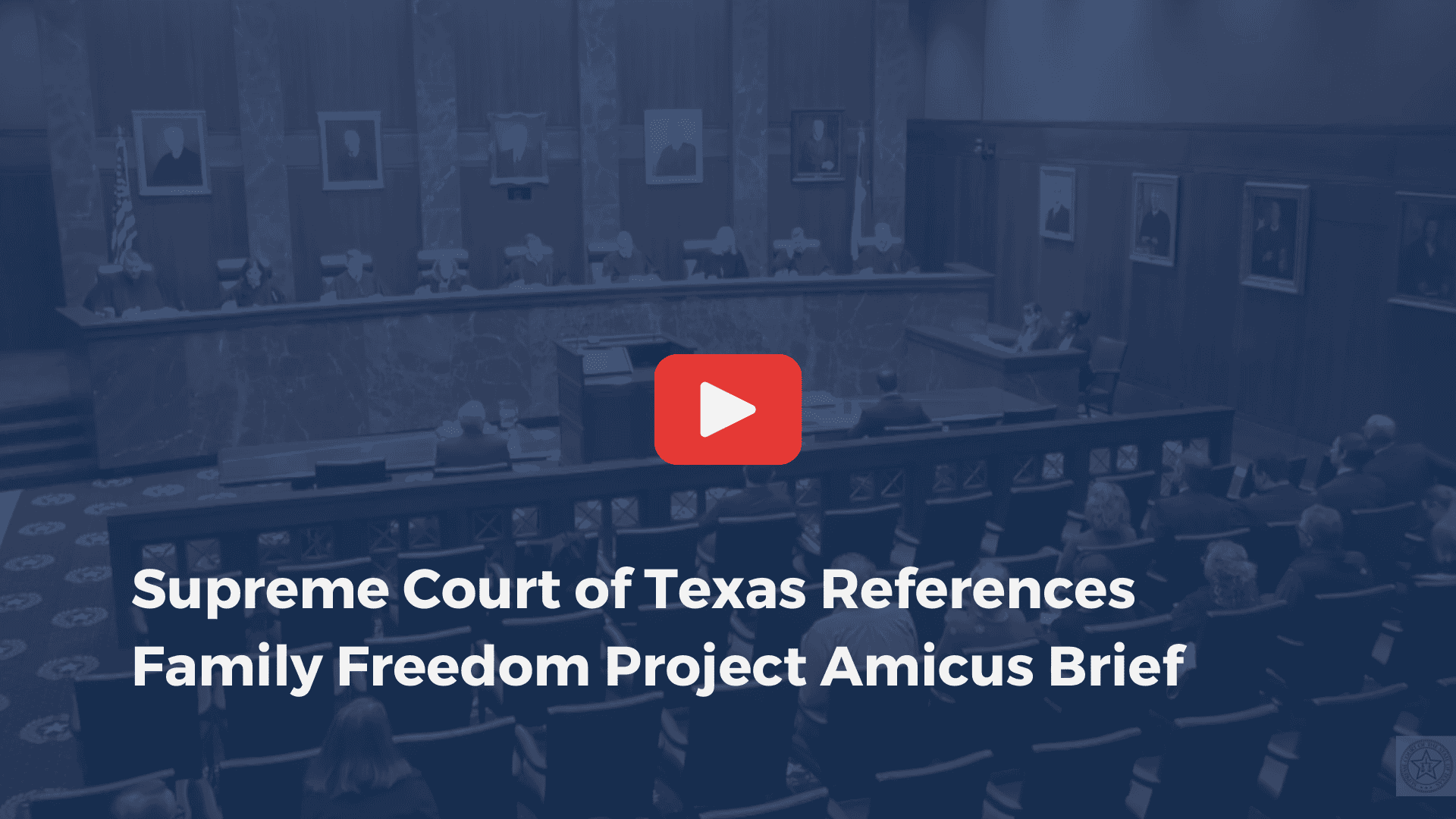
At the conclusion of oral argument, the Court took the unusual step of requesting additional briefing—specifically focused on the Parental Rights Amendment and its implications.
That request brought us to January.
The Current Round of Briefing
This week, multiple new briefs have been filed in the case. Each approaches the problem from a different angle, but they all orbit the same central question:
What limits does the Texas Constitution place on the State’s power over families?
Some of the briefs focus on specific defects of the law—arguing that certain Texas laws should be narrowed or eliminated. Others emphasize evidentiary failures, pointing out that the State relied heavily on parental noncompliance rather than actual harm to justify removal.
Each of those arguments addresses a different facet of the same constitutional concern.
Family Freedom Project’s Role
In our supplemental amicus brief, Family Freedom Project does what we have consistently done in this case: zoom out to the broad, constitutional level.
Rather than focusing on one procedural error or one factual dispute, we ask the Court to clarify the rule that must govern all state action against families.
Our position is straightforward:
- The Parental Rights Amendment means what it says.
- When the State interferes with a parent’s fundamental rights, it must satisfy strict scrutiny.
- That requires the state to only interfere if necessary to protect a child from harm, and to do so through the most careful method possible to avoid damage to the family.
In this case, the State did not treat its intervention like a surgical response to a real emergency. Instead, it used its immense power in a way that expanded over time, ultimately dismantling a family when the state itself had repeatedly concluded there was no imminent danger to the children.
Our brief urges the Court to give real meaning to the constitutional boundary the People of Texas just placed into law—to explain not just that parental rights are fundamental, but how courts must enforce that principle in practice.
Why This Matters Beyond One Case
This case is about one family, but the Court’s decision will shape how thousands of families are treated in the future.
If the Parental Rights Amendment is to be more than symbolic, courts must apply it consistently and seriously. That means requiring the State to justify its actions with evidence, precision, and restraint.
The Texas Supreme Court now has the opportunity to do something rare and important: to define the limits of state power over families.
Family Freedom Project is proud to be at the center of that effort, and we will continue to keep you informed as this case moves toward a decision.

Jeremy Newman, J.D. serves as Vice President at the Family Freedom Project, where he oversees all legislative, political, and litigation-related efforts. He received his Juris Doctor from Oak Brook College of Law and has over a decade of legal and legislative experience.